What to do in Croatia: 15 best places and activities you must not miss
July 6, 2026Contents
Show- Quick answer
- Ferry or catamaran
- Ferry routes from Split
- Ferry and passenger ship routes from Zadar
- Ferry routes to Cres, Pag and Rab
- Ferry routes to Pelješac, Korčula and Mljet
- Ferry timetables and suspended services
- Tickets, reservations and prices
- Travelling by ferry with a car
- The most popular catamaran routes
- Routes between Croatia and Italy
- FAQ: ferry routes in Croatia
Updated for the 2026 ferry timetables. Always check the exact timetable and price again for your travel date.
This guide gives you more than a list of ferry routes in Croatia. It also answers the more important questions: whether you need a ferry or a catamaran, which port you are actually departing from, approximately how long the crossing takes, whether a purchased ticket guarantees a place on your chosen departure and where to check if the service is operating when strong bora winds begin to blow.

Quick answer
- Travelling with a car: look for a car ferry route and check before purchasing whether the departure is reservable or whether the ticket is valid for several departures on the same route.
- Travelling without a car: compare ferries, catamarans and conventional passenger ships; a catamaran often departs from the city harbour and arrives closer to the centre of your destination.
- Looking for the Jadrolinija timetable: enter the exact date, departure port and arrival port. Summer and winter timetables are not the same.
- Strong bora or jugo winds are blowing: check Jadrolinija notices and HAK maritime traffic updates before departure.
- Travelling in July or August: allow plenty of extra time when travelling with a car, especially in Split, Gaženica and on short island routes at weekends.
The ferry becomes the easy part of your plan once you know which island you will be staying on. Browse accommodation in Croatia and then choose your port and route according to the actual location of the property.
Ferry or catamaran: answer this question first
The most common beginner’s mistake is searching for a “ferry to Hvar” without considering whether you need a vehicle on the island. Ferries and catamarans serve different purposes and often do not even arrive at the same port.
Ferry
Carries both passengers and vehicles. Choose it when travelling to an island by car, motorcycle or camper van, or when you want to take more luggage without complications. It usually arrives at a ferry port outside the town centre.
Catamaran
Faster and intended for passengers without cars. It often arrives at the town harbour, such as in Hvar Town, Bol or Korčula, but is more sensitive to adverse weather conditions.
The most important ferry routes from Split
Split Ferry Port is the departure point for Brač, Hvar, Šolta, Vis, Korčula and Lastovo. The distances on the map are not great, but the time you arrive at the port can determine whether you board your planned ferry or have to wait for the next one.
Split – Supetar (Brač)
around 50 minThe main connection to Brač and one of the busiest ferry routes in the country. It is a practical choice if you are travelling towards Supetar, Postira, Sutivan, Bol or the island’s interior.
Practical advice: expect congestion around the ferry port in summer and arrive earlier than your navigation app suggests.
Split – Stari Grad (Hvar)
around 2 hrsThe main ferry route to Hvar when taking a car to the island. From Stari Grad, continue by road towards Hvar Town, Jelsa, Vrboska and other destinations.
Do not confuse the two: the Split – Hvar catamaran arrives in Hvar Town but does not carry cars.
Drvenik – Sućuraj (Hvar)
around 35 minA good option when arriving from the direction of Makarska, Ploče or Dubrovnik and staying on the eastern side of Hvar.
Check before deciding: if you are heading to Hvar Town, a long drive across the island awaits you after disembarking.
Split – Vis
around 2 hrs 20 minThe ferry connection for passengers travelling with a car. If you are travelling without a vehicle, compare the ferry and catamaran because their journey times and schedules differ.
During the season: this is not a route for which you want to arrive at the last minute.
Split – Rogač (Šolta)
around 1 hrThe most convenient route to Šolta with a car. From Rogač, you can quickly continue towards Grohote, Nečujam, Stomorska or Maslinica.
Split – Vela Luka – Ubli
several hoursAn important connection to western Korčula and Lastovo. The journey time depends on the departure, intermediate stops and seasonal timetable, so do not plan this route according to a general average.
Split can be a convenient base before an early departure. Browse apartments in Split, apartments on Brač or apartments on Hvar.
Ferry and passenger ship routes from Zadar
In Zadar, the most important thing is knowing which port you are departing from. Vehicle ferries generally depart from Gaženica, while the Zadar – Preko passenger ship departs from the city harbour on the Peninsula. Going to the wrong port here is not a minor inconvenience: you will need additional driving time to travel between them.
Gaženica – Ošljak – Preko (Ugljan)
around 25 minThe correct choice if you are taking a car to Ugljan. It departs from Gaženica Ferry Port rather than central Zadar.
Zadar – Preko
around 25 minA convenient route for a day trip without a car. It departs from the city harbour and arrives in Preko, so there is no need to travel to Gaženica.
Gaženica – Brbinj (Dugi otok)
around 1 hr 40 minThe main ferry connection to Dugi otok. A car is useful there because Sali, Telašćica, Veli Rat and Sakarun are situated quite far apart.
Biograd – Tkon (Pašman)
around 20 minA short route to Pašman, also useful if you are continuing towards Ugljan via the Ždrelac Bridge. It departs from Biograd na Moru rather than Zadar.
If you are travelling early or want to stay close to Gaženica, browse apartments in Zadar.

Ferry routes to Cres, Pag and Rab
In Kvarner, your choice of port depends on the direction from which you are arriving. You can reach Cres via Krk or Istria, Pag is served by the Prizna – Žigljen ferry and also has a road alternative via Pag Bridge, while the main ferry connection to Rab departs from Stinica.
Valbiska (Krk) – Merag (Cres)
around 25 minThe most logical route to Cres when arriving from Rijeka, Zagreb or via Krk Bridge. Additional crossings may be introduced during the season when required.
Brestova – Porozina (Cres)
around 20 minA convenient route when travelling to Cres from Pula, Rovinj, Labin or elsewhere in Istria. The road after Porozina is slower and winding, so the ferry is not the only part of the journey you need to account for.
Prizna – Žigljen (Pag)
around 15 minThe shortest route to northern Pag from Kvarner and Lika. The service may be suspended during strong bora winds, in which case the road alternative is Pag Bridge.
Stinica – Mišnjak (Rab)
around 15 minThe most common way to reach Rab from the mainland. The route is operated by Rapska plovidba, so its timetable and tickets may not be available in the same place as Jadrolinija services.
For a longer stay, browse apartments on Rab or apartments on Pag, depending on the route and the part of the island where you plan to stay.
Ferry routes to Pelješac, Korčula and Mljet
In southern Croatia, ferry crossings are often only one part of a longer road journey. Looking at the crossing time alone is therefore not enough: check how long it takes to travel from the motorway to the port and from the arrival port to your accommodation.
Orebić – Dominče (Korčula)
around 15–20 minA short and frequent connection from Pelješac. Dominče Ferry Port is located a few kilometres from Korčula Town.
Ploče – Trpanj (Pelješac)
around 1 hrIt can shorten or make the journey towards Pelješac and Korčula more comfortable, but compare the total travel time with driving via Pelješac Bridge for your exact destination.
Prapratno – Sobra (Mljet)
around 45 minThe main ferry connection to Mljet. If you are travelling to the island without a car, also check the catamaran services from Dubrovnik to Sobra or Polače.
Staying on Korčula for several days? Browse apartments on Korčula before deciding whether arriving via Orebić or Vela Luka is more convenient.
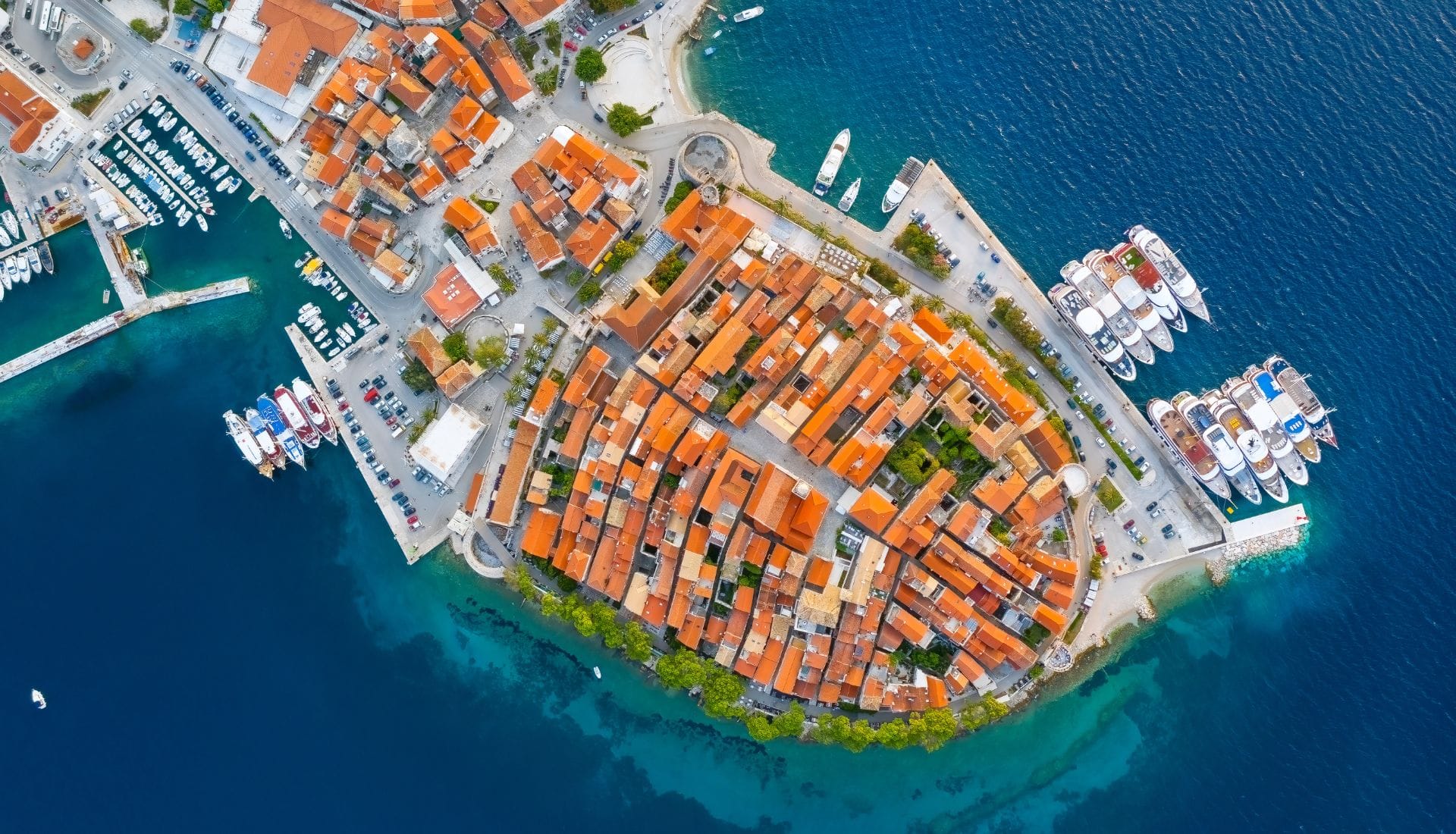
Jadrolinija timetable: how to check it correctly
The “Jadrolinija timetable” is not one fixed schedule that applies throughout the year. Departures change according to the season, day of the week, public holidays and occasional timetable amendments. Always check the schedule using your exact date rather than relying on a screenshot or an old blog post.
Enter the actual ports
Do not search only for “Split – Hvar ferry”. With a car, you need Split – Stari Grad, while the passenger catamaran may operate between Split and Hvar Town.
Select the exact date
The summer timetable may include many more departures than the winter timetable, and Saturday may not follow the same schedule as a weekday.
Check the ticket type
On some routes, the ticket guarantees a place on your chosen departure; on others, it is valid for several departures on the same route and boarding depends on when you arrive at the port.
Check the status on the day of travel
The timetable tells you when the vessel is scheduled to depart. Notices from the operator and HAK tell you whether it is actually operating in the conditions on that day.
Jadrolinija – local routes and timetables, Jadrolinija – online ticket purchases, Coastal Liner Services Agency – 2026 routes and HAK – current traffic conditions.
Suspended Jadrolinija services and HAK maritime traffic updates
During strong bora winds, pay particular attention to the Prizna – Žigljen route and catamaran services. Jugo winds more often cause problems on exposed and southern routes. Do not assume that a “large ferry always operates”: the operational decision depends on the route, vessel and actual conditions.
Jadrolinija tickets, online purchases and ferry prices
Buying your ticket online is the simplest option, but purchasing in advance does not mean the same thing on every route. The most important step is reading the message displayed beside your chosen departure: does the ticket guarantee boarding on that specific ferry, or is it merely valid for the route and date?
What determines the ferry price
- the departure and arrival ports
- the season and current price list
- the number of passengers
- the type, length and height of the vehicle
- additional items such as bicycles, trailers or larger camper vans
- any concessionary passenger or vehicle status, where applicable
Ticket tied to a specific departure
Your purchase reserves a vehicle space for a particular departure. You must still arrive on time and observe the operator’s stated boarding deadline.
Ticket valid for a route and date
It may also be valid for another departure on the same route, but it does not guarantee that your vehicle will be accepted if you arrive after capacity has been reached.
We do not list fixed prices in this guide because fares vary according to the route and season. For the exact amount, open the official online shop and enter your date, number of passengers and correct vehicle category. This prevents you from comparing the price for a passenger car with the price for a van, camper van or vehicle with a trailer.
How to travel by ferry with a car without unnecessary stress
Arrive early, but plan according to the route
A short local crossing outside the main season does not require the same time allowance as Split – Vis in the middle of August. At weekends and on peak changeover days, allow more time.
Check the exact port
Gaženica is not Zadar City Harbour, Stari Grad is not Hvar Town, Dominče is not central Korčula and Mišnjak is not Rab Town.
Prepare what you need on deck
Access to the vehicle deck may be restricted after boarding. Take documents, medication, water and anything needed for children with you before leaving the vehicle.
Do not plan a tight connection
If you have a flight, international ferry or long onward road journey after the crossing, allow time for queues, boarding and possible weather-related changes.
On the vehicle deck, follow the crew’s instructions, park as close as possible to the vehicle in front of you, apply the handbrake and switch off the alarm if the movement of the vessel could activate it. Check the operator’s rules for pets, bicycles and special luggage before purchasing your ticket.
The most popular catamaran routes
A catamaran makes the most sense when you are travelling without a car and want to arrive directly in a tourist destination. Routes from Split to Hvar, Bol, Milna and Korčula are among the most popular, but schedules and operators are not the same on every route.
| Route | When it is convenient | What to watch out for |
|---|---|---|
| Split – Hvar catamaran | When you want to arrive directly in Hvar Town without a car. | Do not confuse it with the Split – Stari Grad ferry. |
| Split – Bol catamaran | For reaching Bol and Zlatni rat without driving across Brač. | Check seasonal departures and whether a same-day return is available. |
| Split – Milna catamaran | For western Brač and combined inter-island services. | The route may continue towards other islands. |
| Split – Korčula catamaran | When you want to reach Korčula Town without a car. | Compare the journey time, stops and operator for your chosen date. |
Without a car, you have greater flexibility when choosing a port. For island stays, compare apartments on Hvar, apartments on Brač, apartments on Vis and apartments on Korčula according to where the vessel actually arrives.
Ferry and high-speed passenger routes between Croatia and Italy
International connections differ from short local ferry crossings. For 2026, Jadrolinija lists the Split – Ancona, Split – Bari and Dubrovnik – Bari routes, as well as the Zadar – Ancona high-speed passenger service. The timetable is seasonal, and international travel requires you to allow time for earlier arrival, check-in and travel document checks.
FAQ: ferry routes in Croatia
Is the Prizna – Žigljen ferry operating today?
You cannot determine this from the basic timetable alone. Check the latest Jadrolinija notices and HAK maritime traffic updates. The service may be suspended during strong bora winds, in which case the alternative is reaching Pag via Pag Bridge.
Is there a ferry to Rab?
The main ferry connection is Stinica – Mišnjak, operated by Rapska plovidba. There is also a Valbiska – Lopar route, so the best option depends on the direction from which you are arriving and the current timetable.
How many cars fit on a ferry?
There is no single answer. Capacity depends on the vessel assigned to the route: smaller local ferries carry several dozen vehicles, while larger vessels can carry several hundred. A general capacity figure should therefore never be treated as a guarantee of boarding.
Which ferry goes to Vis?
When travelling with a car, use the Split – Vis ferry route. The crossing takes around 2 hours and 20 minutes. Without a car, also check the catamaran departures from Split.
How long is the Split – Brač ferry crossing?
The Split – Supetar ferry takes around 50 minutes. It is the main car ferry route to Brač, although other ports or catamaran connections may be more convenient for certain destinations on the island.
Is an online ferry ticket also a reservation for my car?
Only on routes marked as reservable. On other routes, the ticket may be valid for the date and route, while vehicles are boarded according to arrival time and available capacity. Always read the information displayed beside the specific departure.
How much does the ferry to Mali Lošinj cost?
There is no single price without knowing the departure port, date, number of passengers and vehicle type. Enter the complete route in the official online shop to obtain the exact amount; the price from Zadar will not be the same as a journey via Cres.
How early should I arrive at the ferry port?
It depends on the route and season. When travelling with a car on busy summer routes, allow at least 60 to 90 minutes, and even longer for more remote or infrequent departures. On reservable routes, observe the official boarding deadline.
The best plan is not simply to find the “fastest ferry”, but to coordinate the port, vehicle, accommodation location and actual timetable. Once you arrange these details before departure, the ferry stops being a logistical problem and becomes the first part of your island holiday.