


Trogir — a complete city guide
A museum town on a small island: the cathedral with Radovan’s Portal, Kamerlengo Fortress, the beaches of Čiovo and everything you need for a perfect visit — with tips on where to stay and how to get there.
- UNESCO heritage site (1997)
- Near Split Airport
- Ideal for 1–2 days
Key facts for planning
Essential information about the city and everything you need to know before you go.
Central Dalmatia, Croatia
UNESCO heritage site (1997)
The cathedral and Radovan’s Portal
A small island between the mainland and Čiovo
May–June and September
1–2 days (+ day trips)
Split (Resnik) ~5 km
21220 · +385 21
Where it is and what it is known for
Trogir is a historic town and port in Central Dalmatia, around 27 km west of Split. Its old town is set on a tiny island between the mainland and the island of Čiovo, connected by bridges — making it a place best explored on foot, street by street.
Thanks to its exceptionally well-preserved Romanesque-Gothic core and Venetian architecture, Trogir has been on the UNESCO World Heritage List since 1997. Its roots go back to the Greek settlement of Tragurion from the 3rd century BC.
Its greatest highlight is the Cathedral of St Lawrence with the famous Radovan’s Portal, along with Kamerlengo Fortress, Cipiko Palace and the lively waterfront. Its proximity to Split Airport also makes it an ideal first or final stop on a trip.
Advantages
- A compact, walkable UNESCO-listed old town
- Right next to Split Airport (~5 km)
- A base for Split, Čiovo, Krka and the Blue Lagoon
Good to know
- Crowds in the narrow old town in summer
- Aircraft noise in parts of the surrounding area 🔶
- Few beaches in the old town — the best ones are on Čiovo
Fun facts about Trogir
Nine details that make the town special — perfect conversation starters as you wander through the old town.
A UNESCO site since 1997
The old town is considered one of the best-preserved Romanesque-Gothic towns in Central Europe and has been UNESCO-listed since 1997.
A town on an island
The entire historic core lies on a tiny island between the mainland and Čiovo, connected by bridges on both sides.
Greek Tragurion
The town was founded in the 3rd century BC by Greek colonists under the name Tragurion — giving it a history of around 2,300 years.
Radovan’s Portal (1240)
The main portal of the Cathedral of St Lawrence, created by Master Radovan in 1240, is a masterpiece of Romanesque-Gothic sculpture in Croatia.
Kamerlengo Fortress
This 15th-century Venetian fortress on the western edge of the island once guarded the town and harbour; today, it serves as a viewpoint and summer stage.
The Cipiko family palaces
The Large and Small Cipiko Palaces from the 15th century bear witness to the most powerful Trogir family of the Renaissance era.
The relief of the god Kairos
The Monastery of St Nicholas preserves a Hellenistic relief of Kairos, the Greek god of the “right moment” — a world-class rarity.
A town of Renaissance masters
The sculptor Ivan Duknović came from Trogir, and his works are now kept in both the Louvre and the Vatican — more on notable people below.
The closest town to the airport
Split Airport is located in nearby Resnik, only around five kilometres from Trogir — ideal for the first or last day of your trip.

The bridge that cost more than one million euros
In December 2024, Trogir received a new pedestrian bridge across the Foša canal, replacing the old wooden structure. The entire steel structure was assembled in a shipyard, transported by sea and installed in just one evening, while a net stretched above the sea in the middle provides a place to relax.
The project was selected through an architectural competition, and the cost rose from an estimated €800,000 to more than one million euros — because the foundations of the old bridge had not been built according to the approved project and had to be reconstructed. The bridge quickly became one of the city’s most photographed new spots, while the guest of honour at the opening was — St Nicholas, who was the first to cross it, accompanied by kindergarten children.
Famous people from Trogir
From Renaissance masters to contemporary musicians — the town has produced names known far beyond its walls.
One of the leading sculptors of the early Renaissance, originally from Vinišće near Trogir. He worked in Rome and at the court of Matthias Corvinus, while his statue of St John the Evangelist can be seen in Trogir Cathedral. His works are also held in the Louvre and the Vatican.
ArtThe most prominent member of the powerful Cipiko family of Trogir; a Venetian commander and humanist who wrote about the Ottoman–Venetian War. The famous Cipiko palaces in the old town remain as the family’s legacy.
HistoryA native of Trogir who is considered the father of Croatian historiography. In his work “Memorie istoriche di Tragurio” (1673), he wrote the first critical history of his hometown.
HistoryBorn in Trogir; Bishop of Veszprém and Ban (viceroy) of Croatia, he was one of the leaders of the defence against Ottoman incursions in the early 16th century.
HistoryA Dominican from Trogir, Bishop of Zagreb and later of Lucera, known for his learning and care for the poor. The Catholic Church venerates him as Blessed.
ChurchOne of the most beloved Dalmatian singers, born in Trogir. His klapa and popular songs remain synonymous with Dalmatian music and the sea.
MusicTrogir’s main sights
Almost everything is inside the small old town — just a few minutes’ walk away.

Cathedral of St Lawrence
The city’s main gem, with Radovan’s Portal (1240) and the Renaissance Chapel of Blessed John of Trogir. Climb the bell tower for views over the rooftops.

Kamerlengo Fortress
A 15th-century Venetian fortress on the edge of the island; its ramparts open up views of the sea and Čiovo. In summer, it hosts concerts and festivals.

Cipiko Palaces
The Large and Small Palaces of Trogir’s most powerful family, with a Renaissance portal linked to the names of Duknović and Firentinac.

City Loggia and square
The main square with the cathedral, City Loggia and clock tower — the heart of Trogir’s public life through the centuries.

Waterfront and town gates
A seaside promenade overlooking Čiovo, leading through the Land Gate and Sea Gate and past St Mark’s Tower. Ideal at sunset.

Relief of Kairos
The Monastery of St Nicholas preserves the famous Hellenistic relief of the god of the “right moment” — a small detail of world-class value.
Orientation
Map of Trogir and weather
Main locations and current conditions in one place. Click a marker on the map for details and directions.
Marked: Cathedral of St Lawrence · Kamerlengo · Waterfront · Okrug Gornji (Čiovo) · Pantan · Medena · Split Airport
Weather in Trogir
The best areas to stay in Trogir
Choose according to your type of trip — from the historic old town to the beaches of Čiovo.
Old town (island)
All the sights on your doorstep and the unique atmosphere of stone-paved lanes. The most atmospheric choice, but lively in summer and with no parking right outside.
Čiovo (Okrug Gornji)
The widest choice of beaches and apartments, within easy reach of the old town across the bridge; ideal for swimming and family holidays.
Seget Donji
A quieter place west of the town, close to Medena Beach; good value and within easy reach of the old town.
Near the airport (Resnik)
Practical for early flights or arrivals and departures; the old town is just a few kilometres away.
The best beaches in and around Trogir
Most are on neighbouring Čiovo and towards Seget — ranging from lively beaches to peaceful coves.

A long, lively beach (“Copacabana”) with pebbles, bars and facilities; the most popular in the area.

A pebble beach beside the protected Pantan wetland reserve; a combination of swimming and nature within easy reach of the old town.

A long pebble-and-concrete beach west of the town, next to the hotel of the same name; suitable for families.

Turquoise shallows by the islets of Krknjaši; a favourite destination for half-day boat trips.
🔶 Tip: for the most peaceful swimming, explore the small coves along Čiovo towards Slatine; many are accessible by car or boat.
Trogir in half a day, 1 day and 2 days
Ready-made suggestions you can adapt to your own pace.
Trogir in half a day
The highlights in one walk.
- Stop 1Cathedral of St Lawrence
Radovan’s Portal and the climb up the bell tower.
- Stop 2Square and Cipiko Palaces
The City Loggia and old town.
- Stop 3Kamerlengo and the waterfront
Ramparts, sea views and coffee by the water.
Trogir in 1 day
The town + swimming.
- MorningExplore the old town
As above, without rushing.
- AfternoonBeach on Čiovo
Okrug Gornji or Pantan.
- EveningWaterfront and dinner
A konoba in the lanes of the old town.
Trogir in 2 days
Add a day trip.
- Day 1Town and beach
As above.
- Day 2 — option ASplit or Krka
Dalmatia’s main city or the waterfalls.
- Day 2 — option BBlue Lagoon
A full-day boat trip and swimming.
How to get to Trogir
Check changeable information (timetables, prices) before departure. 🔶
By plane — Split Airport (Resnik)
Split Airport is located in Resnik, only around 5 km from Trogir — closer to the town than to any other Dalmatian destination. Taxis, local buses and Uber/Bolt run to the old town; many visitors also go on foot or by bicycle. 🔶
By car — motorway and distances
Trogir is close to the A1 motorway junction (Prgomet/Vučevica exit). Approximate distances 🔶:
- Split — ~27 km, around 30–40 min by car 🔶
- Šibenik — ~55 km 🔶
- Zagreb — ~360 km 🔶
In season, park on the edge of town (mainland/Čiovo), as the old town is pedestrian-only.
By bus
Suburban lines from Split to Trogir run frequently (via Kaštela), with the journey taking approximately 40–60 min; there are also intercity routes from other towns. 🔶
By boat and catamaran
In season, excursion boats and scheduled services run towards Split, along with boat trips such as the Blue Lagoon. Services change seasonally — check before travelling. 🔶
The best time to visit Trogir
May–June and September offer warm sea temperatures with fewer crowds in the narrow old town.
May – June
Pre-season
Pleasant for exploring the old town, the sea is warming up, and crowds and prices are lower than in summer.
July – August
Peak season
The height of the season: warm sea, but also the biggest crowds and heat. Visit the old town in the morning or evening.
September – October
Post-season
Warm sea with fewer people — often the best balance of experience and value.
November – March
Winter
A peaceful town without crowds, ideal for cultural sightseeing and quiet walks. Limited swimming.
Food and local experiences
What to try: fresh fish and seafood, black risotto, Dalmatian pašticada and lamb, as well as traditional “gregada” fish stew.
Where to look: konobas in the lanes of the old town away from the main square, as well as along the waterfront and on Čiovo, where locals also eat.
Something sweet: look for rožata and local cakes; we are preparing a separate article with specific restaurant recommendations.
Must-try
- Grilled fish
- Black risotto
- Pašticada
- Gregada
- Dalmatian prosciutto
- Rožata
- Local wines
Day trips from Trogir
A city, waterfalls, a fortress and turquoise coves — all within easy reach by car or boat.

Split
Dalmatia’s main city with Diocletian’s Palace; around 30–40 minutes by car or bus.
More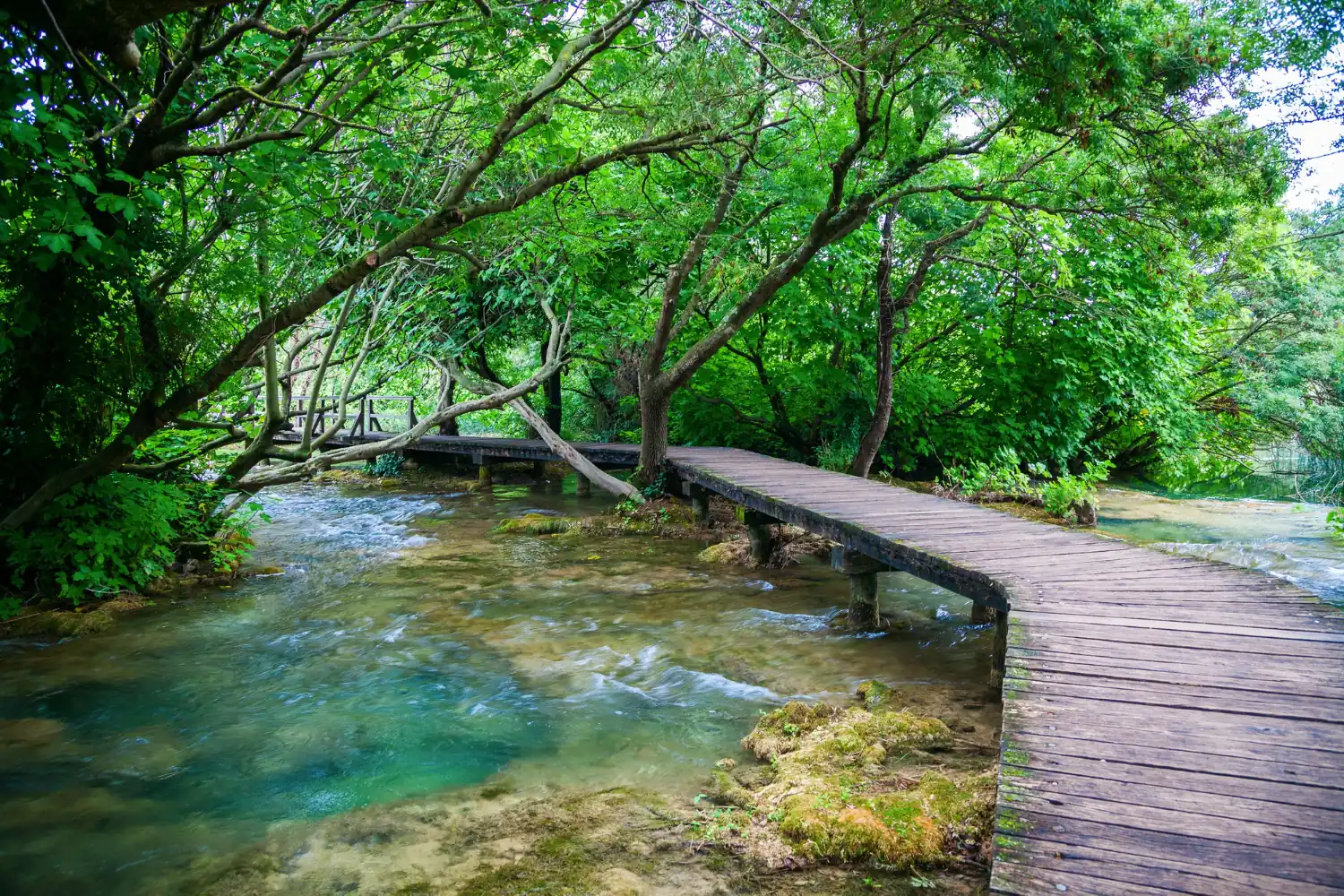
Krka National Park
Waterfalls and walking trails in the national park; a popular full-day trip north of Trogir.
MoreBlue Lagoon
Turquoise shallows by Krknjaši; a half-day boat trip for swimming and snorkelling.
More
Klis Fortress
A historic fortress above Split with sweeping views; also known from “Game of Thrones”.
More
Šibenik
A city with the UNESCO-listed Cathedral of St James and several fortresses; around 50 minutes’ drive north.
More
Island of Čiovo
Beaches, coves and viewpoints right next to Trogir; explore Slatine and peaceful bays by car or boat.
MoreEverything travellers most often ask about Trogir
How much time do you need for Trogir?
Half a day to one day is enough for the old town itself. If you want to swim on Čiovo and take a trip (Split, Krka, Blue Lagoon), plan 2 days.
Is Trogir worth visiting?
Yes — its UNESCO-listed old town, with the cathedral and Radovan’s Portal, is among the most beautiful in Dalmatia, and everything can be explored on foot. It is also ideal as a quieter base near Split.
How far is Trogir from Split and the airport?
It is around 27 km from Split (30–40 min), while Split Airport in Resnik is only about 5 km away — Trogir is the closest town to the airport. 🔶
What are the must-see sights in Trogir?
The Cathedral of St Lawrence with Radovan’s Portal and the bell tower, Kamerlengo Fortress, the Cipiko Palaces, the City Loggia and a walk along the seaside waterfront.
Where are the best beaches?
Most are on neighbouring Čiovo (Okrug Gornji), towards Seget (Medena) and near the Pantan reserve. For a special experience, take a boat trip to the Blue Lagoon.
Do you need a car in Trogir?
Not for the old town itself — it is pedestrian-only and small. A car is useful for beaches on Čiovo and day trips; in summer, park on the edge of town as spaces by the gates are limited. 🔶
Can you combine Trogir and Split in one day?
Yes — because they are close, many visitors explore Trogir in the morning and Split in the afternoon (or the other way round). They are connected by bus, car and seasonal boat services.
When is Trogir least crowded?
Early in the morning and in the evening, as well as in May, June, September and October. In the middle of a summer day, the narrow old town can become very crowded.
Is Trogir good for families?
Very much so — the compact traffic-free old town, beaches and apartments on Čiovo, and proximity to the airport make it practical for a family holiday.
Which famous people come from Trogir?
Notable names include Renaissance sculptor Ivan Duknović, humanist Koriolan Cipiko, historian Ivan Lučić, Ban Petar Berislavić, Blessed Augustin Kažotić and singer Vinko Coce.
Where should you stay in Trogir?
The old town for atmosphere, Čiovo (Okrug Gornji) for beaches and families, Seget Donji for peace and value, and the airport area for transit.
How much is entry to the cathedral and Kamerlengo?
The cathedral (with the treasury and bell tower) and Kamerlengo Fortress charge admission, and prices and opening hours change by season. 🔶 Check before visiting.
Related guides and articles


Plan your holiday in Trogir with verified accommodation
Apartments, villas and rooms in Trogir, on Čiovo and in the surrounding area — find accommodation that suits your trip.